
Tuesday, 2 October 2012

Monday, 30 July 2012
Digital brush strokes

"Painting with a digital brush is an attempt to free ASCII Art from the confines of the screen and enable it to exist in physical space – with simply light and paint."
Source: creativeapplications.net
Painting with a Digital Brush from Teehan+Lax Labs on Vimeo.
Friday, 13 July 2012
Monday, 9 July 2012
These walls can talk
O (Omicron) from Romain Tardy (AntiVJ) on Vimeo.
O (Omicron) - A permanent installation directed by Romain Tardy & Thomas Vaquié Hala Stulecia, Wroclaw, Poland. "When opened, Hala Stulecia was the largest reinforced concrete structure in the world. With a diameter of 65m it was home to the largest dome built since the Pantheon in Rome eighteen centuries earlier. The piece proposed for the Centennial Hall of Wroclaw is based around the notion of timelessness in architecture, and the idea of what future has meant throughout the 20th century. By using references such as Fritz Lang’s Metropolis or the utopian projects of Archigram to confront the different visions of the future at different times, Romain Tardy and Thomas Vaquié were interested in trying to create a vision of a future with no precise time reference. A timeless future." Source: antivj.comSunday, 8 July 2012
The age of biological machines
"Isn't an astonishing idea that life can be programmed like a machine and then the components can be simply ordered online from a standardized toolkit, and this means that engineers and computer scientists and mathematicians can come together with biologists. This is a totally new way of doing science and it's happening right now".
"Playing God", presented by Adam Rutherford, BBC documentary, 2012
Friday, 22 June 2012
Drones out in safari
"Will Burrard-Lucas, a wildlife photographer, built the armored "BeetleCam" so that his camera could get up close and personal with dangerous animals. After some trial and error, he headed to Kenya's Masai Mara with his brother, Matt Burrard-Lucas, to photograph the lions there. The adorable remote-control vehicle ended up doubling as a toy for the lion cubs, making for some amazing images."
Source: The Atlantic
The aesthetics of the post-human
Images made of numbers. A virtual presence, auto-instantiated in direct connection from the source. Real-time portraits of complex sets of movements. Non anthropomorphological reflections of bodily actions. Non gendered, neutral images of functions. Non-conscious perceptions actualized in material, virtual forms. Bodies in motion converted into symbols. Bodies in control. Sense-making machines. Fleeing mirrors.
Saturday, 16 June 2012
"Content is Queen", a generative video painting
"Content is Queen" by Sergio Albiac is a portrait created using an innovative generative technique developed by the artist called "generative video painting". This generative portrait reflects on the foundations of democracy and the resilient nature of the structures of power.
Friday, 15 June 2012
Experiences of infinite space
 "Fireflies on the Water, by Japanese artist Yayoi Kusama, offers an out-of-this-world experience from the confines of a modest room paneled with mirrors and adorned with 150 tiny beads of light deliberately suspended throughout the compact space. Upon entering the room, there's an illusionary effect that gives the impression of infinite space reflected on all sides and in the two inches of water that flows below."
Image and text from My Modern Met
Thursday, 14 June 2012
Bodies in transition
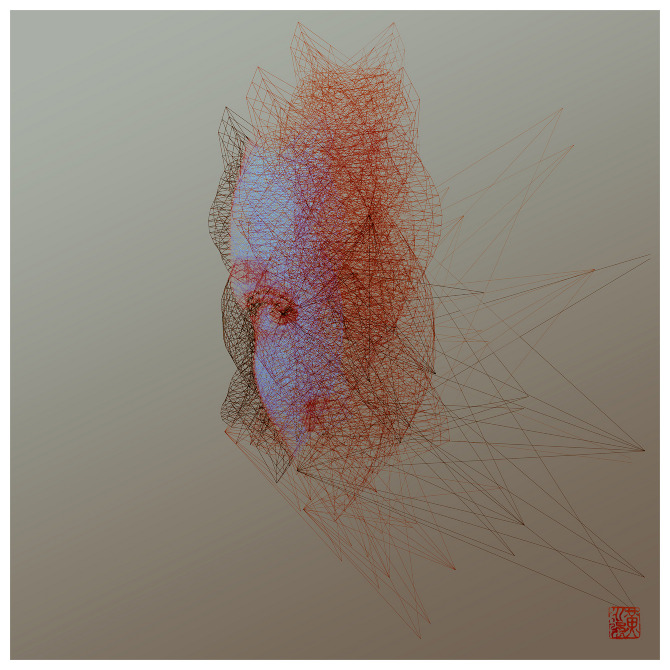
As seen on My Modern Met (more artworks in this link).
Tuesday, 12 June 2012
Lead and technology will follow
 I've read an interesting article in the New York Times called "Are We Living in Sensory Overload or Sensory Poverty?" by Diane Ackerman. She gives some great insights which help bringing to the surface the notions of embodiment, presence and the senses in the discussion of human-technology relationships. I'd like to comment on some of her ideas.
"... we’re living in sensory poverty, learning about
the world without experiencing it up close, right here, right now, in
all its messy, majestic, riotous detail. The further we distance
ourselves from the spell of the present, explored by our senses, the
harder it will be to understand and protect nature’s precarious balance,
let alone the balance of our own human nature."
I believe that the search for balance is key in the face of any technological innovation and so-called "progress". Encouraged by scientific intelligence and high doses of imagination, technology tends to expand itself to the level of science-fictional proportions, but when it faces human interaction, this comes as a reality check that puts it back on its tracks. Any technology that do not align to and serve the human condition and its purposes will fail, because technology is only in relation to the biological realm. In this sense, how useful is to long for a previous historical period of life under certain bio-technological conditions in which humanity used to be more in contact with nature?
The senses are at work also in our relationship with technology, but they are contested by its apparent complexity, although more so is technology, which undergoes the test of human perception. What doesn't pass the sensory and corporeal scrutiny, it will fade as a useless technology. Presence is also in our interaction with any kind of technology, like when driving a nail with a hammer or browsing the Internet.
But of course, I understand what Ackerman is referring to: how can I know what a tree is if I haven't seen it, touched it, felt it... how can I ever truly know India if all I have seen are photos in a computer... it's true that digital media seem to be getting between us and the concrete world we live in. But there are signs of balance, which is evident as media technology is increasingly going mobile. Our bodies, our senses, our drive to interact with nature have taken the development of technology to more intuitive, safer, grounds. In this world, everything is in constant change, and "transitioning" is the normal state of things. If we want for things to fall into the right place, we just have to exercise that human quality that it is all about being present: patience.
Thursday, 24 May 2012
Big Data markets and individual freedom, a new frame for an eternal dispute

In the online article by Inc. Magazine called "Business Opportunities in Big Data", it is stated that Big Data is hot because:
"In an increasingly digitized world, everything you do creates an electronic record—every purchase, doctor's visit, or instance you "friend" someone on Facebook. As organizations continue to amass hundreds of terabytes of that information, they are looking for more sophisticated software tools to mine and analyze it, to help businesses better understand their markets and customers, and even predict what's next."
It is clear that if Big Data is a market, then our digitized actions are treated as commodities. Information sourced from our own digital actions are being used or sold to governmental or commercial entities but we're also buying it ourselves (let's say you're paying Linkedin to access more and better information about the state of your professional online relationships).
As technology always evolve in an experimental phase, we also follow by jumping into those new developments, until it comes a time to assess and make meaning of that technology and our relationship with it. In the Big Data context, now that the movement is going mainstream and it is big enough to become a market, it is time (again) to revise the meaning of individual freedom and autonomy. The only thing we have freedom for in this world is to decide what we want to think about our individual position in relation with the technologies we evolve with. When it comes to our bodies and actions, we've always been subjected to our connection with other entities and technologies. In fact, we are "in connection".
For me, the notion of the market of Big Data is just another technical way of visualizing and administering the connections and relationships that make the world, those that of course existed even when the previously analog materiality of media didn't allow us to recognize (although we've always felt them). As there is another way of seeing what has always been happening, the time has come to revise how we want to think about ourselves in this new media context, to ask ourselves if we are willing to understand our identities in function to the state of the media through which they actualize. Either you fight the Big Data movement and the challenges it supposedly represents to our identities and privacy or you consciously choose to attune to it by understanding that it could be just another stage in the history of our bio-technical evolution.
Of course, we may not be free from the constraints of media forms that shape our social life but we can be critical about the direction that is taking, and that freedom should be non negotiable. Change can only come from within.
Image credits: Inc. Magazine and Viegas/Wikipedia
Saturday, 5 May 2012
Your digital image doesn't look like you

Bodies are not anymore those that are reflected by the mirror, but those revealed by the statistics of their actions. The digital image of the body is not a virtual reconstruction of its physical structure but a numerical report of how it is performing. It doesn't matter how it looks as long as the body is sending vital signals of what it is doing, how it is doing and where it is. A virtual body is always "checking-in", updating other bodies or machines with its functional data. The new image is one that shows the relational body, one in constant movement. The quantified, bio-mediated body is an informational interface; it is not an autonomous entity with a defined visual image but rather a shapeless body that exists entirely in co-creation with everything it is connected to.
Image source: new-aesthetic.tumblr.com
Wednesday, 2 May 2012
Diving into the past of the future

There is nothing ever new but hardly old things become updated, refashioned. It is rather a matter of naming. For example,
 the functional quality of "paper" doesn't belong to the paper itself but to many other different things like, let's say, the ipad. What "dies" or gets replaced is just the name of the thing, but not its function. We can say "paper" is dying but in fact it is the word that may be going out of fashion. Its functionality just gets remediated into another technological device made of a different material that serves for the same purpose.
Sunday, 29 April 2012
Images you can read
"Imagine if descriptive metadata about each photo could be appended to the image on the fly—information about who is in each photo, what they're doing, and their environment could become incredibly useful in being able to search, filter, and cross-reference our photo collections."

Created by Matt Richardson, the Descriptive Camera is a regular photo camera which instead of producing an image, outputs a text description of the scene using Amazon's Mechanical Turk API. This is an interesting project that makes us think about what an image really is and how it works, exploring other ways to engage with its content. In my opinion, it triggers similar debates about narrative forms, content and meaning as in the case of a book when is made into a movie.

Images: mattrichardson.com/Descriptive-Camera

Created by Matt Richardson, the Descriptive Camera is a regular photo camera which instead of producing an image, outputs a text description of the scene using Amazon's Mechanical Turk API. This is an interesting project that makes us think about what an image really is and how it works, exploring other ways to engage with its content. In my opinion, it triggers similar debates about narrative forms, content and meaning as in the case of a book when is made into a movie.

Images: mattrichardson.com/Descriptive-Camera
Wednesday, 25 April 2012
Big Data: an introduction in 10 tweets
 This week, between April 19-28, 2012, the Big Data Week has been taking place in 3 countries simultaneously, consisting in 50 meetups about Dig Data. A panel session held in London featured the brightest minds in the Big Data industry:
* Doug Cutting, co-founder of the Apache Hadoop project and creator of Nutch and Lucene
* Nick Halstead - Founder/CTO DataSift
* Hilary Mason – Bit.ly Chief Scientist
* Andy Kirk – Visualising Data
* Edd Dumbill – Program Chair Strata Conference – Moderator
I couldn't attend the event, but I followed the Twitter conversation on #BigDataWeek. Here there are 10 tweets to help beginners like me understand what kind of issues are involved in the discussion about Big Data:
1. @IanFOsborne Big Data means never having to sample anymore!
2. @michellegallen Education is fragmented and operates in silos. This works against training data scientists who need to work across disciplines
3. @jamesholwell Right on. Insightful data analytics alone won't get board-level attention, has to tell a story (and look pretty!)
4. @jamesholwell Big data in 5 years time: sentiment analysis applied to the whole of humanity (assuming privacy doesn't get in the way)
5. @rosshitch media scientists are rare and tend to generate objective results but businesses need action points
6. @wacinski "There will be regulatory constraints on how we're able to analyse datasets, such as the information held by Facebook"
7. @DavidRajan open data open innovation datascience and big data - is all converging
8. @nick365 okCupid an example of not such big data but very very interesting relationship discoveries from their blog.okcupid.com
9. @FlyingBinary Apart from the finance applications by the panel mentioned there is #bigdata revolution underway in the HR and Research space
10. @darachennis Data is a collection of facts. Can't IP or (c) that. Why not treat data as a legal person? Would prevent lots of dumb lawsuits
Friday, 20 April 2012
There's a product for every emotion
This is a video by Erina Scourti called “Life in AdWords”. She explains: "Every day, I write and email my diary to my Gmail account and copy over the list of suggested keywords linking to clusters of relevant ads, making visible the way we and our personal information are the product in the ‘free’ internet economy."
On the Internet, words don't fade or die. They are destined to a life of infinite existence and relationality. There's always a response to them. Words are bound to always make meaning, and to be attached to another word, which is attached to another one and so on. They become prisoners of contexts to which they don't belong. Words are not intimate, they belong to everyone. On the Internet, we're not one but everybody.
Source: new-aesthetic.tumblr.com
On the Internet, words don't fade or die. They are destined to a life of infinite existence and relationality. There's always a response to them. Words are bound to always make meaning, and to be attached to another word, which is attached to another one and so on. They become prisoners of contexts to which they don't belong. Words are not intimate, they belong to everyone. On the Internet, we're not one but everybody.
Source: new-aesthetic.tumblr.com
Wednesday, 18 April 2012
Technology evolves; stories remain
 |
| Illustration drawn on iPad by Jorge Colombo |
"There was one other big lesson he learned from his Hollywood adventure: People remember stories more than products. "The technology we've been laboring on over the past 20 years becomes part of the sedimentary layer," he told me once. "But when Snow White was re-released [on DVD, in 2001], we were one of the 28 million families that went out and bought a copy of it. This was a film that is 60 years old, and my son was watching it and loving it. I don't think anybody's going to be beating on a Macintosh 60 years from now.""
From "The Lost Steve Jobs Tapes" by Brent Schlender
Art imitates the medium

Adriana Cora, Waiting (Espera), 2012 - Source: Artlog.com
"Zoom in and zoom out" is the new perspective: moving from the whole to the pixel and vice versa.
Subscribe to:
Posts (Atom)