Showing posts with label Digital Media. Show all posts
Showing posts with label Digital Media. Show all posts
Friday, 22 June 2012
The aesthetics of the post-human
Images made of numbers. A virtual presence, auto-instantiated in direct connection from the source. Real-time portraits of complex sets of movements. Non anthropomorphological reflections of bodily actions. Non gendered, neutral images of functions. Non-conscious perceptions actualized in material, virtual forms. Bodies in motion converted into symbols. Bodies in control. Sense-making machines. Fleeing mirrors.

Saturday, 16 June 2012
"Content is Queen", a generative video painting
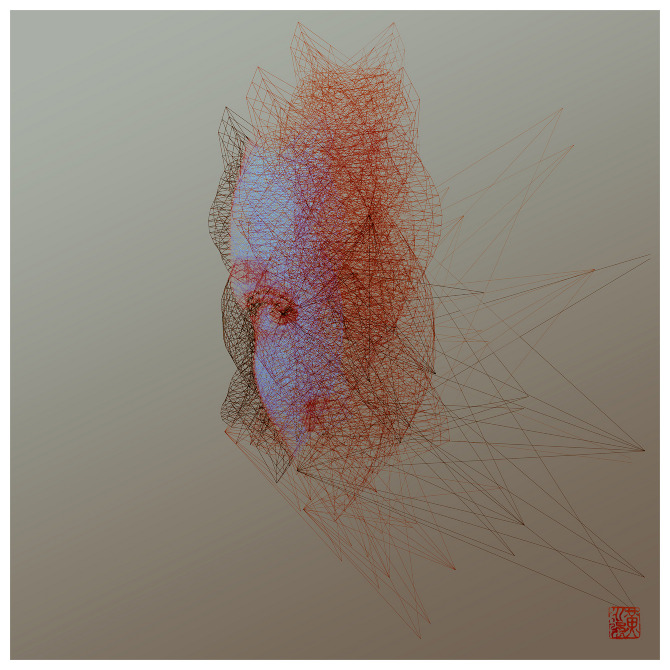
"Content is Queen" by Sergio Albiac is a portrait created using an innovative generative technique developed by the artist called "generative video painting". This generative portrait reflects on the foundations of democracy and the resilient nature of the structures of power.
Thursday, 14 June 2012
Bodies in transition
As seen on My Modern Met (more artworks in this link).
Tuesday, 12 June 2012
Lead and technology will follow
 I've read an interesting article in the New York Times called "Are We Living in Sensory Overload or Sensory Poverty?" by Diane Ackerman. She gives some great insights which help bringing to the surface the notions of embodiment, presence and the senses in the discussion of human-technology relationships. I'd like to comment on some of her ideas.
"... we’re living in sensory poverty, learning about
the world without experiencing it up close, right here, right now, in
all its messy, majestic, riotous detail. The further we distance
ourselves from the spell of the present, explored by our senses, the
harder it will be to understand and protect nature’s precarious balance,
let alone the balance of our own human nature."
I believe that the search for balance is key in the face of any technological innovation and so-called "progress". Encouraged by scientific intelligence and high doses of imagination, technology tends to expand itself to the level of science-fictional proportions, but when it faces human interaction, this comes as a reality check that puts it back on its tracks. Any technology that do not align to and serve the human condition and its purposes will fail, because technology is only in relation to the biological realm. In this sense, how useful is to long for a previous historical period of life under certain bio-technological conditions in which humanity used to be more in contact with nature?
The senses are at work also in our relationship with technology, but they are contested by its apparent complexity, although more so is technology, which undergoes the test of human perception. What doesn't pass the sensory and corporeal scrutiny, it will fade as a useless technology. Presence is also in our interaction with any kind of technology, like when driving a nail with a hammer or browsing the Internet.
But of course, I understand what Ackerman is referring to: how can I know what a tree is if I haven't seen it, touched it, felt it... how can I ever truly know India if all I have seen are photos in a computer... it's true that digital media seem to be getting between us and the concrete world we live in. But there are signs of balance, which is evident as media technology is increasingly going mobile. Our bodies, our senses, our drive to interact with nature have taken the development of technology to more intuitive, safer, grounds. In this world, everything is in constant change, and "transitioning" is the normal state of things. If we want for things to fall into the right place, we just have to exercise that human quality that it is all about being present: patience.
Saturday, 5 May 2012
Your digital image doesn't look like you

Bodies are not anymore those that are reflected by the mirror, but those revealed by the statistics of their actions. The digital image of the body is not a virtual reconstruction of its physical structure but a numerical report of how it is performing. It doesn't matter how it looks as long as the body is sending vital signals of what it is doing, how it is doing and where it is. A virtual body is always "checking-in", updating other bodies or machines with its functional data. The new image is one that shows the relational body, one in constant movement. The quantified, bio-mediated body is an informational interface; it is not an autonomous entity with a defined visual image but rather a shapeless body that exists entirely in co-creation with everything it is connected to.
Image source: new-aesthetic.tumblr.com
Sunday, 29 April 2012
Images you can read
"Imagine if descriptive metadata about each photo could be appended to the image on the fly—information about who is in each photo, what they're doing, and their environment could become incredibly useful in being able to search, filter, and cross-reference our photo collections."

Created by Matt Richardson, the Descriptive Camera is a regular photo camera which instead of producing an image, outputs a text description of the scene using Amazon's Mechanical Turk API. This is an interesting project that makes us think about what an image really is and how it works, exploring other ways to engage with its content. In my opinion, it triggers similar debates about narrative forms, content and meaning as in the case of a book when is made into a movie.

Images: mattrichardson.com/Descriptive-Camera

Created by Matt Richardson, the Descriptive Camera is a regular photo camera which instead of producing an image, outputs a text description of the scene using Amazon's Mechanical Turk API. This is an interesting project that makes us think about what an image really is and how it works, exploring other ways to engage with its content. In my opinion, it triggers similar debates about narrative forms, content and meaning as in the case of a book when is made into a movie.

Images: mattrichardson.com/Descriptive-Camera
Wednesday, 18 April 2012
Art imitates the medium

Adriana Cora, Waiting (Espera), 2012 - Source: Artlog.com
"Zoom in and zoom out" is the new perspective: moving from the whole to the pixel and vice versa.
Monday, 5 December 2011
US losing information war to alternative media
Mediating the same events from multiple angles is always good news, and great if that's happening. The US has been leading the entrepreneurship race and therefore commanding the development and globalization of digital media for decades, a process from which platforms like YouTube were born. But paradoxically, media like these have been allowing the creation of multiple discourses, a situation that worries Hillary Clinton very much, as this video shows:
Monday, 19 September 2011
A not so useful perk
I like Klout. I think it clearly epitomises the state of the current web, with the significant incorporation of metrics for individual interactions. Metrics that have become a measure for social performance, and in some ways, a vanity score. Klout is deeply connected with what the web demands from us that makes it the powerful tool that it is today: information. As you interact with social media you upload information onto the web, you're monitored and awarded a score for your performance. But because you want to perform better and score higher, you then upload more information and interact more, which in turn gives you a better score and rewards or perks. And the cycle goes on and on.
The same dynamic can clearly be seen in searches. If you can find a result on Google, for any word you can imagine, it is mainly due to the fact that information was uploaded by millions of companies and people like me who write blog posts like this one. The uploading of that information is in turn fuelled by the demands and metrics of SEO practices that ask for more optimised content to rank better in the result pages.
What companies and advertisers do with the data they get from our social interactions is to collate it as knowledge to use to target consumers more accurately, like the email I recently received form Klout shows:

The email announced that I had received a perk. That's great, I like perks. Nevertheless, although I appreciate being labelled as a 'key influencer', my Klout score doesn't reflect that. As for today my score is 27 and I am labelled as a mere 'Explorer', which makes perfect sense since I'm not very active on Twitter. Anyway, out of curiosity, I decided to 'claim my perk' and this is what I saw next:

The perk I was awarded was an Axe Hair product. It all seemed perfectly well if it wasn't for the fact that I am bald. So the perk wasn’t really one for me. If it wasn't for the fact that I'm relaxed about my condition, instead of seeing it as a perk, I could have taken the email as a bad joke or felt like if I was being bullied.
But don’t get me wrong, as I said I like Klout. It's just that this little commercial misunderstanding is a great example of how today's highly praised automatisation can have its flaws. It shows that no matter how much information about myself I have uploaded on all the social media channels I use, in the form of videos I share or things I say, I am still not 'there'. My baldness, my insecurities, my vulnerabilities, my motivations to 'like' something or buy a product are still difficult to decipher by algorithms and other types of technological practices and I still cannot be properly 'known' as a person. In today's digital, social and interactive media automatisation, labels and generalisations collide with feelings, life experiences and human complexities. And that is when commercial actions can have undesired results, for the marketer and for the consumer.
I think identity and consumer behaviour are still underestimated in today's digital landscape. Technical advances don't let technocrats see the very thing that hasn't changed: human nature. The people at Klout know this very well when they offer users a way to measure their social influence, which is something we do online and offline, everywhere, everytime and by different means. But the problem is, as always, the urge for 'monetisation', and that is when you start giving hair products to bald people.
Klout is a very clever idea. And I like it because just as it’s amazing features are a faithful representation of the wonders of the Internet today, so they are its mistakes. These mistakes also say a lot about the flaws of today's interactive media and the overrated expectations that companies, marketers, consumers and users have about technology.
The same dynamic can clearly be seen in searches. If you can find a result on Google, for any word you can imagine, it is mainly due to the fact that information was uploaded by millions of companies and people like me who write blog posts like this one. The uploading of that information is in turn fuelled by the demands and metrics of SEO practices that ask for more optimised content to rank better in the result pages.
What companies and advertisers do with the data they get from our social interactions is to collate it as knowledge to use to target consumers more accurately, like the email I recently received form Klout shows:

The email announced that I had received a perk. That's great, I like perks. Nevertheless, although I appreciate being labelled as a 'key influencer', my Klout score doesn't reflect that. As for today my score is 27 and I am labelled as a mere 'Explorer', which makes perfect sense since I'm not very active on Twitter. Anyway, out of curiosity, I decided to 'claim my perk' and this is what I saw next:

The perk I was awarded was an Axe Hair product. It all seemed perfectly well if it wasn't for the fact that I am bald. So the perk wasn’t really one for me. If it wasn't for the fact that I'm relaxed about my condition, instead of seeing it as a perk, I could have taken the email as a bad joke or felt like if I was being bullied.
But don’t get me wrong, as I said I like Klout. It's just that this little commercial misunderstanding is a great example of how today's highly praised automatisation can have its flaws. It shows that no matter how much information about myself I have uploaded on all the social media channels I use, in the form of videos I share or things I say, I am still not 'there'. My baldness, my insecurities, my vulnerabilities, my motivations to 'like' something or buy a product are still difficult to decipher by algorithms and other types of technological practices and I still cannot be properly 'known' as a person. In today's digital, social and interactive media automatisation, labels and generalisations collide with feelings, life experiences and human complexities. And that is when commercial actions can have undesired results, for the marketer and for the consumer.
I think identity and consumer behaviour are still underestimated in today's digital landscape. Technical advances don't let technocrats see the very thing that hasn't changed: human nature. The people at Klout know this very well when they offer users a way to measure their social influence, which is something we do online and offline, everywhere, everytime and by different means. But the problem is, as always, the urge for 'monetisation', and that is when you start giving hair products to bald people.
Klout is a very clever idea. And I like it because just as it’s amazing features are a faithful representation of the wonders of the Internet today, so they are its mistakes. These mistakes also say a lot about the flaws of today's interactive media and the overrated expectations that companies, marketers, consumers and users have about technology.
Subscribe to:
Posts (Atom)